Cumbia is one of the most widely danced musical forms in Latin America, heard from the Caribbean coast of Colombia to the suburbs of Buenos Aires, Mexico City and Los Angeles. Its origins are contested; its ingredients are not seriously disputed. What changes — sharply, depending on which country's scholars you consult — is the weighting given to each of those ingredients.
Three layers are consistently identified: Indigenous flute tradition, West and Central African percussion, and Iberian harmonic structure. The argument is about proportion, emphasis and, underneath both, national cultural investment.
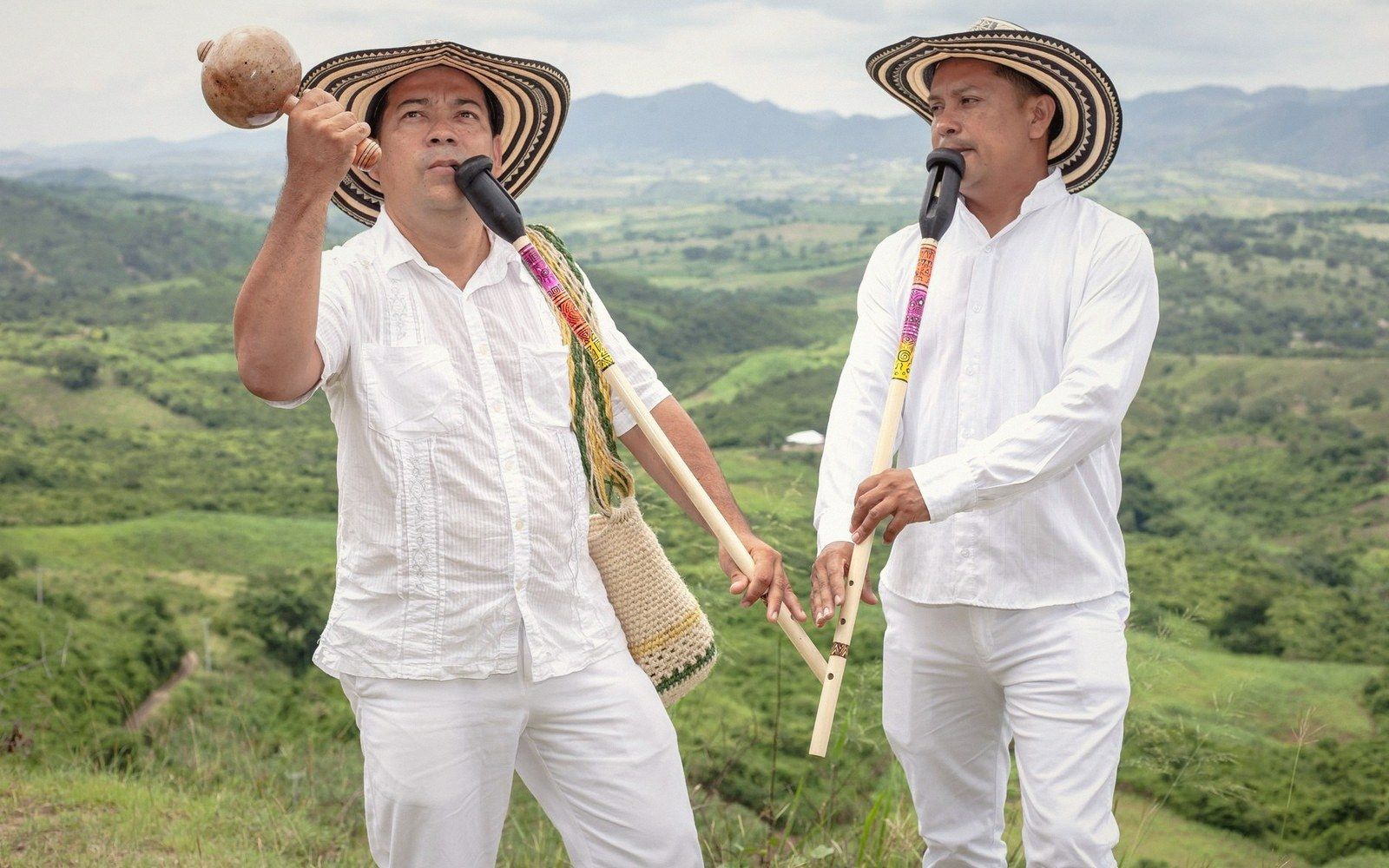
The gaita — a duct flute carved from the dried stalk of the cardón cactus, sealed with beeswax and coal, and fitted with a feather quill as a mouthpiece — is the instrument most Colombian musicologists treat as the irreducible core of cumbia. There are two paired forms: the gaita hembra (female, the melodic lead) and the gaita macho (male, the rhythmic counterpoint). Both were documented among the Kogui, Chimila and other peoples of the Sierra Nevada de Santa Marta and the broader Caribbean lowlands before sustained European contact.
Colombian musicology, rooted in mid-twentieth-century work at institutions like the Instituto Colombiano de Antropología e Historia, has consistently foregrounded this layer. The gaita ensemble — flutes, maracas, and a single drum — is framed as the original unit onto which other elements were later grafted. This is partly a matter of evidence and partly a matter of cultural politics: establishing an Indigenous centre for the country's most internationally recognised popular form carries obvious weight.
The drums tell a different story — or at least tell their part of the story more loudly. The tambor mayor (the large barrel drum), the llamador (a smaller drum that holds the pulse) and the alegre (the improvisational lead drum) are organologically traceable to West and Central African drum-making traditions carried by enslaved people to the Colombian coast, principally through Cartagena, one of the largest slaving ports in the Americas. The rhythmic vocabulary — the interlocking patterns, the call-and-response between drums — is what gave cumbia its danceability and its tensile energy.
Scholars working in Afro-Latin American studies, including researchers at Colombian institutions and across the broader Caribbean academic world, argue that the drums are not an addition to an Indigenous frame but a co-constitutive element without which cumbia as a recognisable form does not exist. The question of whether the gaita ensemble preceded or developed alongside the drum ensemble remains genuinely open. Archaeological evidence for the drums in a specifically cumbia context is scant; the gaita's documentation reaches further back on paper, but paper reached the coast with Europeans.
The harmonic structure — the chord progressions, the melodic phrasing influenced by Iberian folk song, the use of diatonic scales — is the layer most easily underweighted, particularly in Colombia, because it sits inside the music less visibly than a flute or a drum. It arrives in the voice, in the melodic contour, in the way a phrase resolves. The accordion, now so central to vallenato (the closely related form that shares much of cumbia's geography and instrumentation), entered the region in the nineteenth century and reinforced harmonic patterns already present.
Mexican musicologists and the enormous popular-music industry that developed cumbia as a distinct Mexican phenomenon — particularly in the 1960s and 1970s through labels and orchestras that remade the form for urban audiences — have tended to emphasise the European harmonic inheritance precisely because it is the layer that made cumbia legible to other musical traditions. The Iberian structure is, in this reading, what made cumbia exportable.
The three layers are real. The scholarly disagreement about their relative importance is also real, and it maps reasonably cleanly onto where scholars are based and what national cultural narratives they are working within. Colombian scholars have most invested in the Indigenous centre; Afro-Latin American studies has pushed back with the drums; Mexican popular-music scholarship has often foregrounded the harmonic portability that made cumbia a pan-continental form.
None of these readings is wrong. Cumbia is genuinely all three things at once — a gaita melody, a drum conversation, a borrowed chord — and the fact that you can argue endlessly about which layer matters most is itself a reasonable measure of how fully each one belongs.