Cuban son is one of the most consequential musical forms of the twentieth century — the rhythmic backbone that fed into salsa, the harmonic template that gave Afro-Cuban jazz its structure, the vehicle that carried Cuban music to every continent. Its origins, however, are genuinely contested, and the musicologists who study them have not settled the argument. What can be said with confidence is which elements fed into it, and where those elements came from.
The geography matters from the start. Son did not emerge from Havana, though Havana is where it became famous. Its roots are in the eastern provinces — the region Cubans call Oriente — particularly in the area around Santiago de Cuba and the Sierra Maestra. This was the end of the island that Spanish colonisers reached first and that African enslaved people populated most densely. It was also the end furthest from the capital's cultural administration and closest, by sea, to Haiti and Jamaica. That combination — distance from the centre, density of African cultural retention, proximity to other Caribbean islands — was not incidental. It created conditions in which musical forms could develop without the pressure of metropolitan taste.
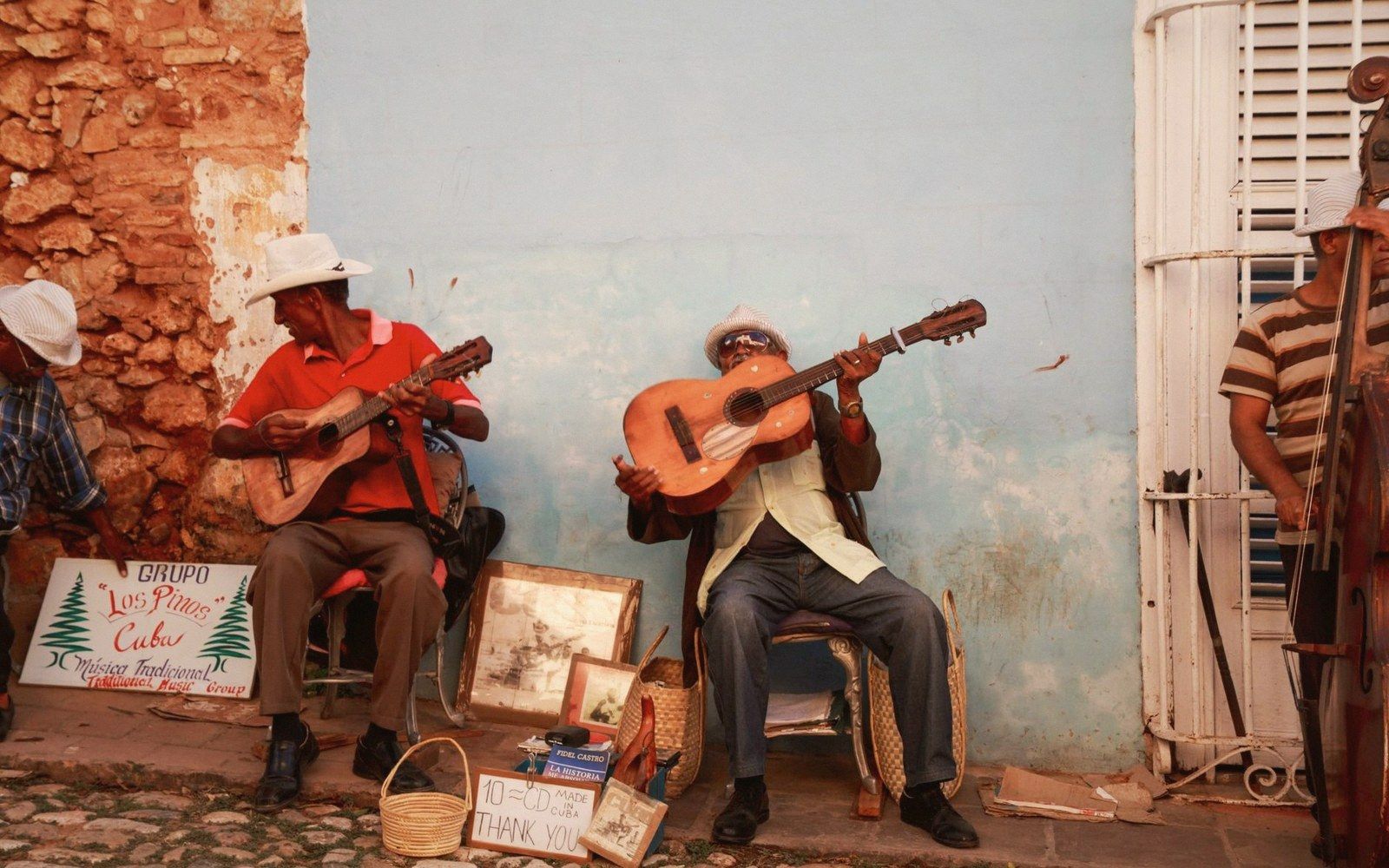
The most immediately audible element in son is the guitar tradition that arrived with Spanish settlers. The instrument most associated with early son is the tres, a Cuban-evolved guitar strung in three doubled or tripled courses that produces a bright, cutting sound quite distinct from the standard guitar's warmth. The tres traces its design to the Spanish guitar family, and the melodic and harmonic vocabulary of son — its use of the tonic, subdominant and dominant, its verse and chorus structures — is firmly rooted in the Spanish musical inheritance that spread across Cuba from the sixteenth century onward.
Against that harmonic framework, son sets rhythmic structures that come from a different source entirely. The clave — a two-bar rhythmic pattern, typically rendered as three strokes followed by two or two followed by three, depending on context — functions as the organising spine of the music. It is played on the clave sticks themselves, two polished wooden cylinders struck together, and everything else in a son ensemble is oriented around it. This kind of interlocking rhythmic organisation, in which different instruments hold different parts of a larger pattern that only makes sense when heard together, is traceable to West and Central African musical traditions carried to Cuba by enslaved Yoruba, Bantu and Fon people. The same principle of interlocking parts governs the batá drums used in Lucumí religious ceremony, and the relationship between son's rhythmic structures and those ceremonies is not merely analogical — musicians moved between both worlds.
The bongó, the pair of small open-bottomed drums played with the hands and tuned to different pitches, is the percussion instrument most distinctively associated with early son, and its origins lie in those African traditions filtered through Cuba's eastern provinces. The marímbula — a large lamellophone, essentially an amplified thumb piano used to hold the bass line in early son ensembles — connects still more directly to the African mbira family of instruments.
What makes Oriente specific rather than generically Afro-Caribbean is worth pressing on. Santiago de Cuba in particular was a city shaped by waves of migration that other parts of the island did not share in the same proportions: French colonists fleeing the Haitian Revolution in the early nineteenth century arrived bringing their own musical practices, including the contradanza and tumba francesa traditions. That influx added another layer of rhythmic complexity and formal structure to an already mixed cultural landscape.
The earliest documented references to son as a named form date to the late nineteenth century in Oriente, though the word was used loosely and described a range of related practices rather than a fixed form. By the first decades of the twentieth century, groups such as the Trío Oriental and, later, the Sexteto Habanero were performing and recording what had consolidated into recognisable son — the combination of the tres, guitar, bongó, maracas, claves and bass, playing a music structured around the alternation between a fixed melodic section and a call-and-response montuno passage in which the singers improvise over a repeating harmonic loop.
It was that montuno section — open-ended, improvisatory, driven by the rhythmic engine of the clave — that proved most generative for the music that followed. Salsa, mambo, Cuban jazz and their descendants all feed from it. The argument about who invented son, and exactly when, may never be resolved. But the elements that composed it — Spanish harmony, African rhythm, the specific cultural crossroads of eastern Cuba — are each well documented, and they are not, in the end, a mystery. The mystery is why that particular combination, in that particular place, produced something that would not stop moving.