The two words translate each other in every dictionary. The spaces they describe are not the same.
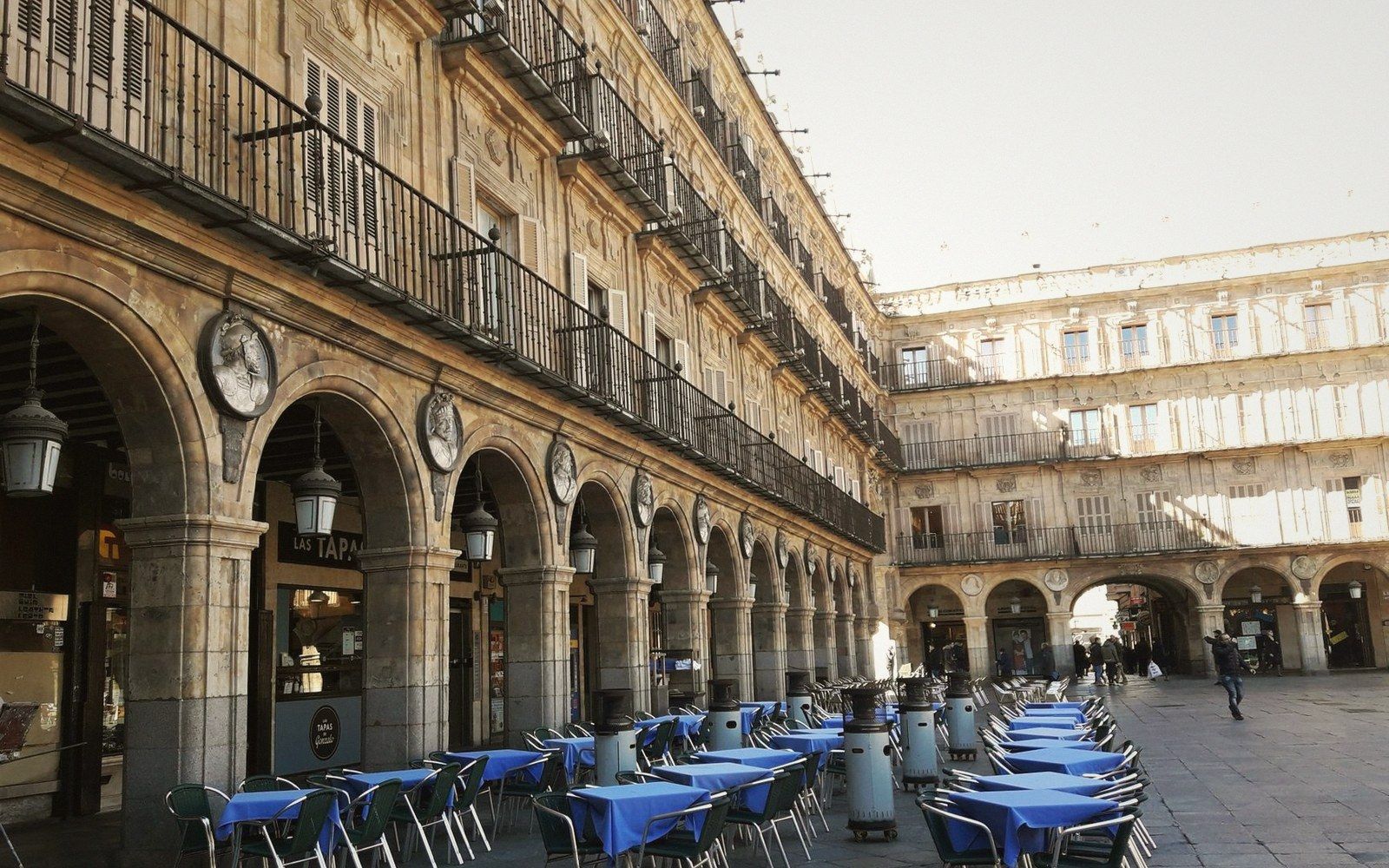
The Spanish plaza mayor — the main square of a colonial or Iberian city — was designed as an enclosure. Its edges were meant to be occupied: the church on one flank, the municipal building on another, a covered arcade (soportales) running along at least one side to shelter commerce. The square itself was the focal point; the surrounding buildings completed it, framed it, gave it civic authority. Walk into Salamanca's Plaza Mayor, or Lima's, or Oaxaca's, and the architecture turns inward, deliberately. The square commands you to stop and look at it.
The Portuguese praça operates differently. It is rarely a hard enclosure. It tends to open at corners, blur into adjoining streets, and allow buildings to stand in front of it as much as around it. The Praça do Comércio in Lisbon is the paradigm case: three sides of uniform arcaded buildings, yes, but the fourth side is the river Tagus. The square doesn't close — it drains toward the water. The architecture defers to geography rather than asserting geometry over it.
That difference in spatial logic produces different social uses. The Spanish plaza is centripetal: it pulls people in and holds them within a defined perimeter, historically to witness, to be witnessed, to attend public events. Portuguese praças tend to be transitional — places you move through rather than linger in, their orientation toward an edge or a view rather than toward a central axis.
None of this is absolute. Regional variation within both traditions is real, and the colonial grid that shaped Spanish cities from Mexico City to Santiago was not applied uniformly. But the underlying impulse diverges early and stays divergent. One square announces the city's authority over its own centre. The other leaves the centre slightly open, as if uncertain whether the city ends here or somewhere beyond the water.