Maize reached both Mexico and the Andes before recorded history, and in both places it became the foundational starch. That is roughly where the similarity ends. The two great maize civilisations developed opposite techniques for processing the grain, and those techniques produced flavour cultures so distinct that the corn of a Mexican market stall and the corn of a Peruvian chicha house share little more than their botanical name.
Mexican cooking runs on nixtamal — maize kernels simmered and steeped in an alkaline solution, typically water and calcium hydroxide (slaked lime, called cal). The process is pre-Columbian, documented across Mesoamerica for at least three thousand years, and its effects are radical. The alkaline bath loosens the hull, restructures the starch and, crucially, makes niacin and essential amino acids biologically available in ways that untreated maize cannot provide. A population eating nixtamalised corn exclusively was nutritionally secure; one eating raw-ground corn was not, as European colonisers who adopted the grain without the technique discovered when pellagra spread across Mediterranean and American southern communities in the eighteenth and nineteenth centuries.
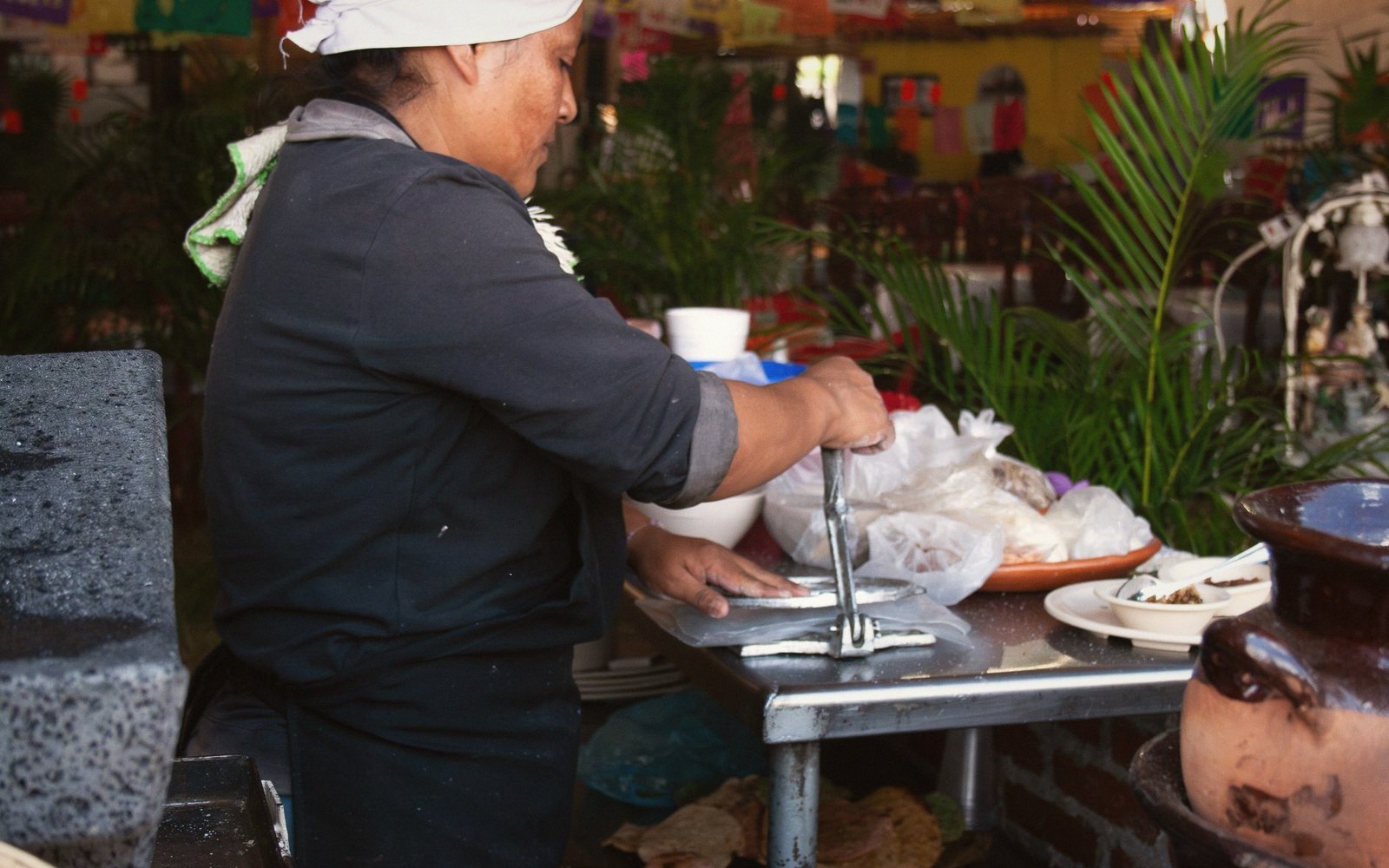
But nixtamal is not only nutrition — it is flavour. The alkaline process generates compounds that give masa (the resulting dough) its specific earthy, slightly mineral taste: the taste that underlies tortillas, tamales, tlayudas and pozole. Masa smells like nothing else. It is dense, plastic, cohesive. Freshly ground on a stone metate, it will hold the impression of a thumb. The flavour this dough imparts is the ground note of Mexican cooking — subtle in a tortilla eaten plain, more assertive in a corn-thickened soup, unmistakable in a tamal slow-cooked in its leaf wrapper.
The Andean tradition takes an entirely different path. In the Quechua-speaking world, the most culturally significant corn preparation is chicha de jora — a fermented drink made from malted maize, in which germinated kernels are dried, ground, boiled and then allowed to ferment. The malting activates enzymes that convert starches to sugars; fermentation turns those sugars to alcohol and acids. The result is sour, slightly effervescent, thin-bodied and complex. In Andean communities today, chicha remains a ceremonial and everyday drink; it is sold from houses whose doors are marked with a red plastic bag or a bundle of flowers, the traditional sign that fresh chicha is available inside.
Alongside chicha, Andean cooks also prize whole-kernel corn preparations — mote (large-kernel hominy, boiled whole), cancha (toasted kernels, eaten dry and crunchy) and choclo (fresh large-kernel corn, boiled and served beside dishes like ceviche). None of these involve nixtamalisation. The emphasis instead is on the kernel's natural sweetness, its texture, its density. Andean maize varieties tend to have larger, starchier kernels than Mexican ones; they are bred for boiling whole or toasting, not for grinding into a homogeneous dough.
The divergence is not incidental. The nixtamal tradition produces a processed, transformed ingredient — corn remade into something new. The Andean tradition, even at its most complex (a multi-day chicha ferment), keeps the kernel identifiable, traceable, itself. Mexican corn cookery is about dough and the infinite things dough can become; Andean corn cookery is about the grain in forms that announce their origin plainly.
A tortilla and a bowl of cancha are both corn. The gap between them is the gap between two complete culinary philosophies — and neither borrows anything from the other.