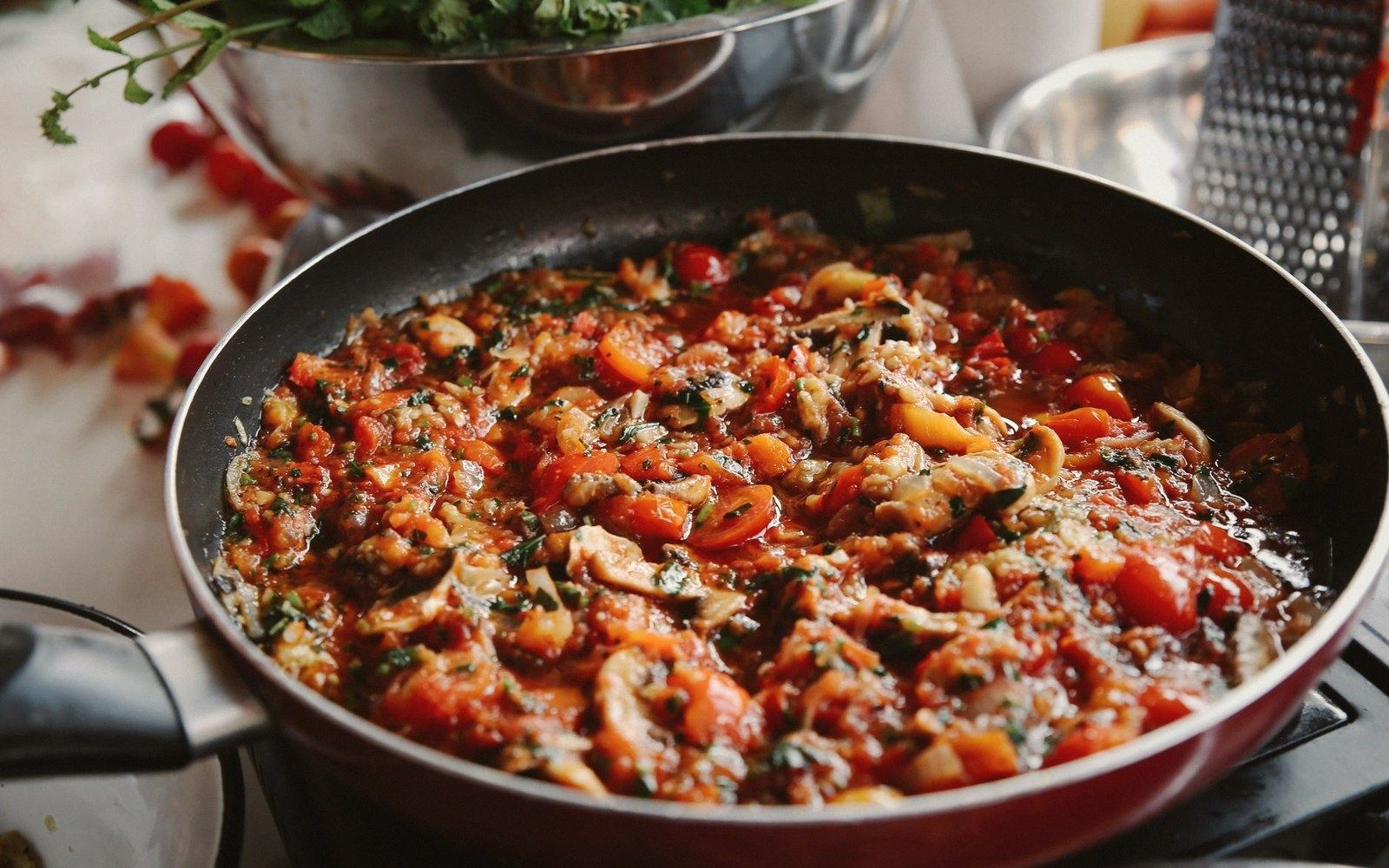
From Mesoamerica to Iberia and back: the tomato travelled twice, and returned changed. Spanish slow-cooked sofrito made it a foundation.
The tomato arrived in Europe as a curiosity. Spanish colonisers encountered it in Mesoamerica — where it had been cultivated, selected and cooked for centuries, appearing in sauces alongside chillies and squash — and carried seeds back across the Atlantic sometime in the sixteenth century. The plant grew readily around the Mediterranean. It resembled the nightshade family in ways that made some Europeans nervous: the leaves are indeed toxic, and the fruit sat on the same botanical branch as mandrake and belladonna. In parts of northern Europe it was grown as an ornamental for longer than it was eaten. Around the Iberian Peninsula and southern Italy, the suspicion faded faster.
Early Spanish and Portuguese records describe the tomato as edible but treat it as a condiment rather than a staple — a sharp, acidic thing to be used in small quantities, closer to the function of a caper or vinegar than the main matter of a dish. The word that arrived with it, from the Nahuatl tomatl, became tomate in Spanish and Portuguese without much alteration, one of the rare cases where the colonial transfer left the name almost intact. By the seventeenth century, Spanish cooks were combining crushed tomato with oil, garlic and onion to make what would eventually solidify into the sofrito — the gently cooked base of fat and aromatics that underpins an enormous proportion of Iberian and later Latin American savory cooking. This was a European invention, this slow-frying technique; the tomato had been cooked in Mesoamerica, but not quite like this.
The sofrito changed what the tomato was. Raw, the fruit is acidic and sharp. Cooked slowly in oil, its water evaporates, its sugars concentrate, its acidity rounds and its colour deepens from bright red to something darker and more complex. Spanish cooks discovered — without calling it by any scientific term — that the Maillard reactions and caramelisation triggered by slow heat transformed the tomato from an addition into a foundation. By the eighteenth century the sofrito base appears reliably in Spanish culinary manuscripts, and variations of it — sometimes with onion alone, sometimes with peppers added — had spread across the peninsula and into Portuguese cooking, where a closely related preparation using olive oil and onion became standard.
Portugal's engagement with the tomato also ran through its trading routes. Portuguese sailors had connected the Atlantic and Indian Ocean worlds, and the tomato, once established in Lisbon's kitchens, moved east along those networks to Goa and beyond. But the more consequential return trip was westward.
When the tomato travelled back to Latin America, it went as a cooked technique, not a raw ingredient. Spanish colonists and the mixed culinary cultures that emerged through the colonial period reintroduced the sofrito method to regions where the tomato had always been native. The effect was a kind of double domestication: the fruit returned to the continent where its wild ancestors had grown, but now embedded in a cooking logic — slow oil, onion, garlic, heat — that the Americas had not independently developed. Mexican cooking incorporated the sofrito alongside its existing traditions of roasting and grinding tomatoes into salsa; the result was a repertoire in which both methods coexist. Roasted tomato on a dry comal (a flat griddle) is not the same dish as a sofrito-based tomato sauce, even when the fruit is identical.
Across the Andes and the Caribbean, the sofrito became structural. In Cuban, Puerto Rican and Dominican cooking, a variation called sofrito — typically blended with peppers, onion, garlic and herbs — is almost obligatory before any main ingredient enters the pan. In Peru, the aderezo, a close cousin, begins most stews. These preparations have local identities now, shaped by the specific vegetables and herbs available, but their logic is Iberian, and Iberia received it from a fruit that came from the other side to begin with.
The tomato is not unusual in having crossed the Atlantic twice. What makes its return striking is that the second crossing was not about the ingredient itself — the Americas already had it — but about a way of handling heat, fat and time. Mesoamerica gave Europe a fruit. Europe gave it back as a method.