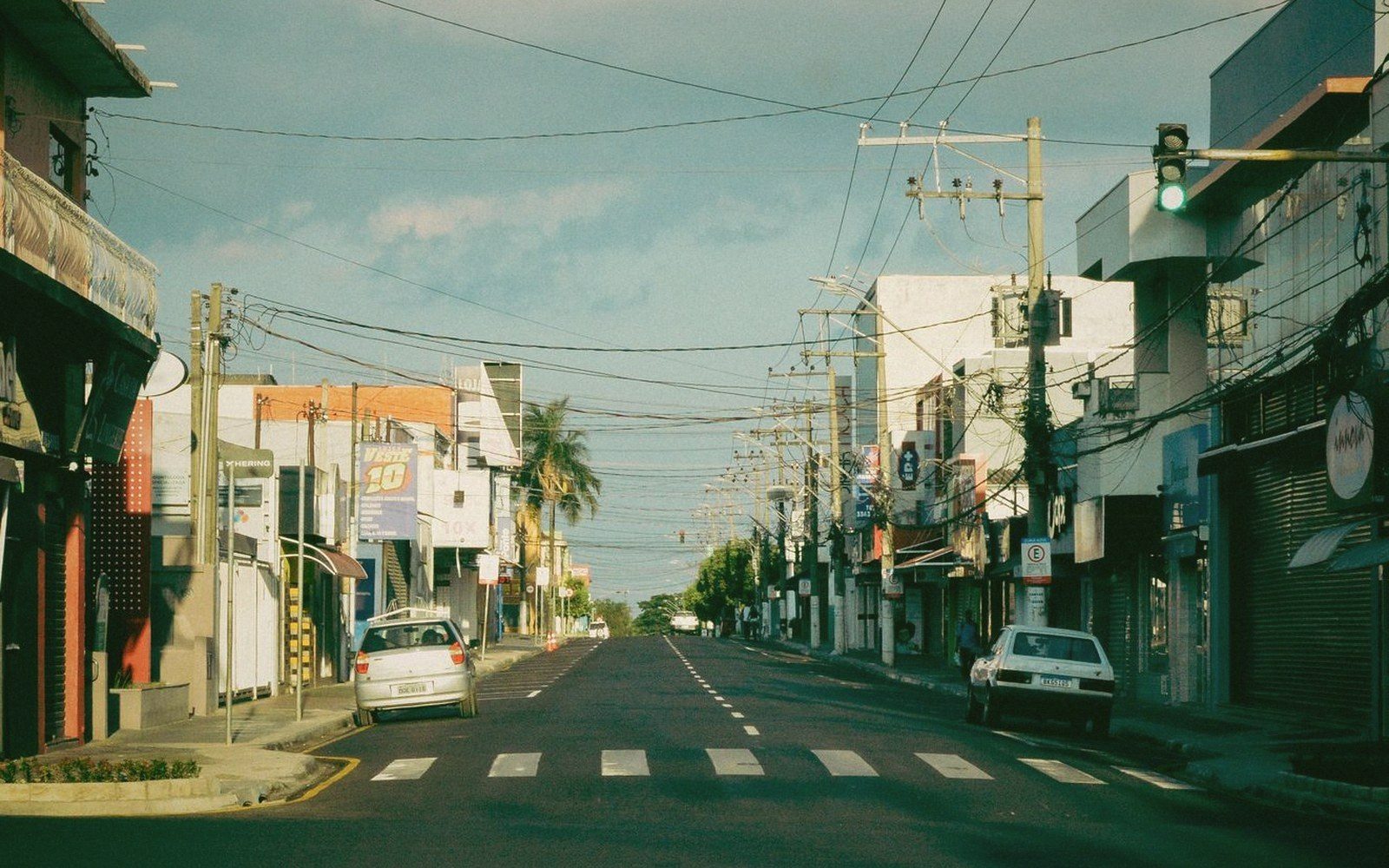
The contact language on the Uruguay–Brazil border is less a blend than a diagnostic: it shows exactly where Spanish and Portuguese pull apart.
The Uruguayan department of Rivera sits flush against the Brazilian city of Santana do Livramento, separated by nothing more than a central avenue. On one side, Spanish is the administrative language; on the other, Portuguese. In practice, a third option circulates freely across both pavements: portuñol, the informal contact vernacular that has existed on this border for generations.
It is tempting — and wrong — to call portuñol a pidgin, a creole, or a simple mixing of two similar tongues. Linguists who have worked directly on the Rivera–Livramento border zone, including Adair Bonini and, more extensively, Patrícia Amaral and others in the broader literature on fronteiriço — the local term for specifically border Portuguese — tend to identify something more structurally interesting. Portuñol is not arbitrary mixture; its seams fall at exactly the points where Spanish and Portuguese are least mutually intelligible. What speakers improvise around, and where the code-switching tends to occur, is a near-perfect map of the two languages' real structural distance.
The most reliable trigger for a switch or a hybrid form is the verb system. Portuguese and Spanish share a large percentage of cognate vocabulary, so border speakers rarely need to reach across for a noun. Verbs are harder. The Portuguese personal infinitive — which inflects for person where the Spanish infinitive does not — is systematically absent from portuñol; speakers default to the Spanish uninflected form or to a regularised Portuguese construction. This is not laziness. It reflects a genuine asymmetry: the personal infinitive in Portuguese has no Spanish equivalent and requires a grammatical category that Spanish simply does not equip its speakers to handle.
Nasal vowels cause comparable trouble in the other direction. Brazilian Portuguese's nasal diphthongs — sounds with no equivalent in River Plate Spanish — are reduced or dropped when Portuguese-dominant speakers shift toward the Spanish phonological frame. Recordings from the Rivera border collected in sociolinguistic fieldwork show that nasal vowels function almost as a register marker: their presence signals a tilt toward Portuguese; their absence signals Spanish territory.
Then there is the matter of false cognates. Border speakers who have grown up using both languages are, by exposure, more aware of the traps than a textbook learner would be — but portuñol still generates characteristic errors around words that look identical and mean different things, particularly in the embarazada/embaraçada and polvo/pulpo class of near-misses. These errors are not random; they cluster around semantic fields — the body, commerce, kinship — where the two languages diverged earliest.
The linguist Elizaincín, who worked extensively on Uruguayan border speech in the late twentieth century, argued that DPU — dialectos portugueses del Uruguay, the Uruguayan Portuguese dialects — constituted a legitimate linguistic system rather than degenerate Spanish or defective Portuguese. The portuñol heard today in Rivera is downstream of that tradition: it is improvised, daily, unselfconscious, and genuinely functional. But its functionality depends on the fact that Spanish and Portuguese share enough surface vocabulary to sustain basic communication — while diverging at precisely the points that formal grammar prioritises: tense, mood, number, and sound.
Portuñol is often cited as evidence that the two languages are almost the same thing. What it actually demonstrates is the opposite: speakers have to work around a set of real, structural incompatibilities, and the workarounds are consistent enough to constitute a system of their own.